

The Middle swing voters who decide the Europe’s climate policy
Europe’s climate policy “swing voters” are bigger than you think – and they’re key to building majorities
When climate policy runs into trouble, the presumed explanation is often polarisation: committed supporters on one side, die-hard opponents on the other, and not much room to move. Our new survey across 13 EU countries suggests something else is going on.
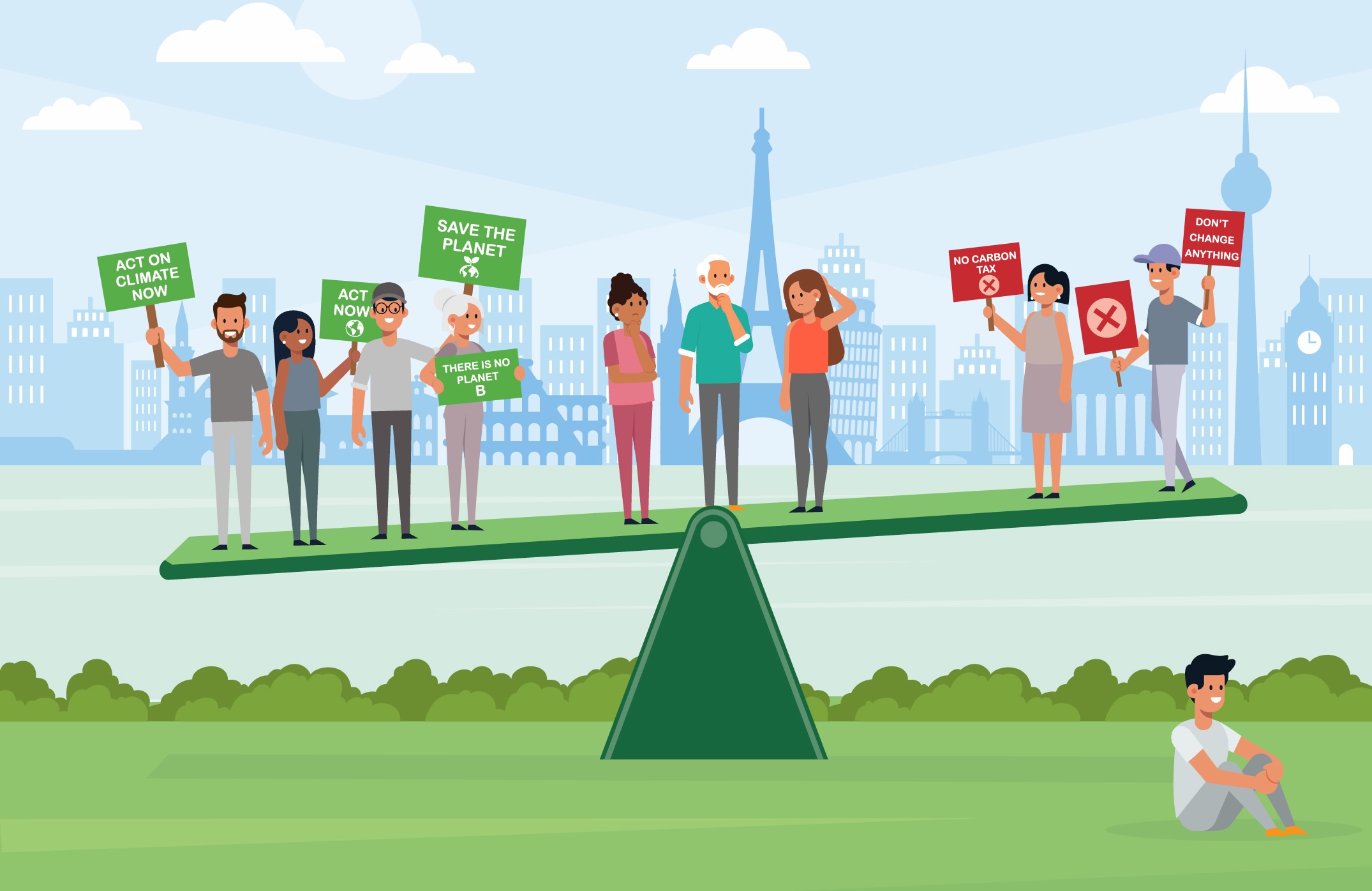
A large share (33%) of Europeans sit in the middle. They aren’t uniformly pro- or anti-climate policy. Instead, their support is conditional: it depends on what the policy is, how it works, and what it costs them.
That group matters because, on many climate measures, it is big enough to decide whether proposals surpass the 50% election majority.
The missing group in climate politics: the conditional middle
As part of the Horizon Europe project CAPABLE, we surveyed ~19,000 adults across 13 EU countries about 15 specific climate policy proposals.
The striking finding is that the public isn’t neatly split into “for” and “against”. A large share sits in the middle.
People in the middle aren’t apathetic. Their views tend to be conditional: they shift depending on how a policy is designed, whether it feels fair, what it costs, and how intrusive it seems. Nor are they politically disengaged: over 70% of the Conditional Middle report that they voted in the last elections for European Parliament.
Because this ‘Conditional Middle’ group is so large, small changes in their support can be enough to tip a policy into (or out of) majority backing.
What moves the conditional middle? Costs, constraints, and the policy tool itself
When we look inside the Conditional Middle group, one factor dominates: their personal cost–benefit calculation.
In our analysis, variation in support among these voters is driven far more by the policy instrument and perceived trade-offs than by political orientation, climate attitudes, demographics, or where people live. In plain terms: for this group, how a policy works often matters more than who they are.
A small tweak can change opinions a lot
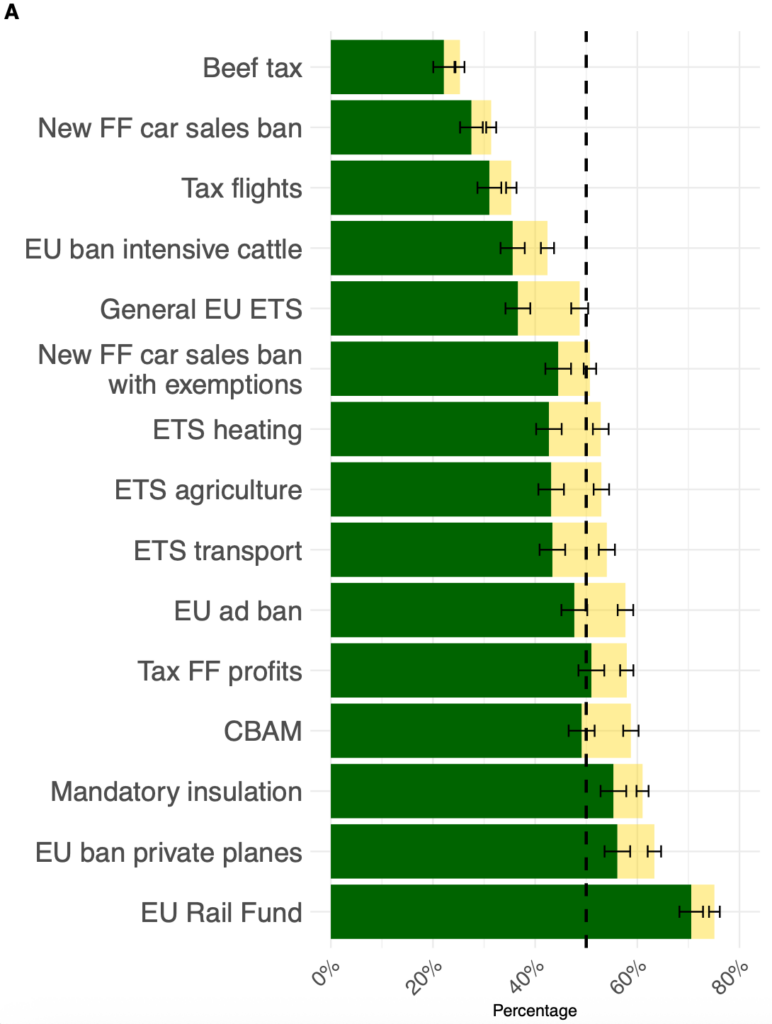
One striking example involves car policies. A general ban on new combustion-engine cars triggers strong resistance among Conditional Middle, but introducing an exemption (for synthetic fuels) reduces rejection dramatically (from 73% to 39%).
Whether synthetic fuels are a good idea in practice can be debated, but politically, it’s a clear illustration of how policy design details change acceptability.
Some policies are consistently more feasible than others
Across the 15 proposals, support levels vary a lot (see Figure 1 below). Measures that impose highly visible, out-of-pocket costs (consumer facing taxes and consumption bans) tend to struggle. Policies framed as shared investments, subsidies, or rules paired with protections for vulnerable households tend to do better.
This isn’t a moral judgement about what governments “should” do to fight climate change, or what is most efficient and effective. It’s an empirical finding about what people in Europe will tolerate, especially among the Conditional Middle who are most persuadable.

Small shifts in the middle can unlock majorities
Here’s why this matters for real politics.
In a simple simulation, if a modest share of the Conditional Middle moved from “unsure” to “support”, the number of proposals with majority backing could rise substantially — from 4 out of 15 to 10 out of 15 (see Figure 2 below).
The Conditional Middle is large, policy design choices that slightly increase acceptability can change what is politically feasible.
Where should “climate money” go? People want visible benefits
We also asked about priorities for using climate-related revenues and funds.
A clear preference emerges: many people — especially the Conditional Middle — favour spending that is directly visible and broadly shared, such as adaptation investments and support for vulnerable households. By contrast, support for compensating workers negatively affected by decarbonisation tends to be lower.
That doesn’t mean worker transitions are unimportant. But it does suggest that, if governments want to hold public coalitions together, they should pay attention to what people perceive as fair, direct, and tangible.
What this means for policymakers (and for how we talk about climate policy)
If the goal is durable majorities for climate action, the implication is not “avoid tough policies”. It’s that implementation choices can make or break support.
Three practical lessons stand out:
- Make fairness legible: People react strongly to who pays and who benefits — and whether support for vulnerable groups is credible
- Treat instrument choice as political strategy: Taxes, bans, subsidies, standards, exemptions: these are not just technical levers. They are cues about cost, control, and flexibility.
- Don’t confuse noisy opposition with public opinion: A large share of Europeans are not hardened opponents. They are conditional supporters — and that’s where many political battles are won or lost.
Article
Smith K, Mlakar Z, Levis A, Sanford M, et al. “Climate Policy Feasibility across Europe Relies on the Conditional Middle” Nature Climate Change. 11.03.2026. Online: https://www.nature.com/articles/s41558-026-02562-8